| How Often Sequencing Error Alone Fakes k Reads | |||
| ≥ k reads | 30x | 60x | 100x |
|---|---|---|---|
| 1 | 0.0296 | 0.0583 | 0.0952 |
| 2 | 0.0004 | 0.0017 | 0.0046 |
| 3 | <1e-04 | <1e-04 | 0.0002 |
| 4 | <1e-04 | <1e-04 | <1e-04 |
Introduction
A tumor biopsy is never pure tumor, it contains normal cells. Therefore when we sequence a tumor/normal pair to find somatic variants each DNA fragment from the tumor will come from the tumor cell or from a normal cell mixed in with it.
Tumor purity is the fraction of cells in a sample that are actually tumor cells. A purity of 1.0 would mean every sequenced cell is tumor. For somatic variant calling it is important as it sets the ceiling on how much of the DNA we sequence carries the mutation: the lower the purity, the smaller that signal — and, the harder it becomes to tell a real variant from a sequencing error.
Say tumor purity is 5%. If we have a variant for which we have 100 reads (100X coverage), then about 5 come from tumor cells. If the mutation is heterozygous — present on only one of the two copies at that position — only half of the tumor-derived fragments carry it, so roughly 2 to 3 out of the 5. On average then, about 2.5 carry the mutation. This 2.5% fraction is called the variant allele frequency, or VAF.
Sequencing error
Sequencing has its own error rate, independent of the tumor. At Q30 base quality, the standard threshold, roughly 1 in 1000 bases (0.1%) is misread by chance.
At the same 30x depth, the expected number of error reads at any given position is:
\[E(\text{error reads}) = \text{depth} \times \text{error rate} = 30 \times 0.001 = 0.03 \text{ reads}\] That’s the sequencing error rate — what to expect even where nothing real is happening. Therefore, at 30X and 5% tumor purity, a real mutation is expected to produce ~0.75 reads, and pure noise is expected to produce ~0.03 reads. Both are small, and telling them apart is very hard.
This 0.1% figure assumes errors are random and uniform, which real Illumina data isn’t. Most false positives instead cluster at systematic artifacts: homopolymer/repeat slippage, strand bias and PCR duplicates, oxidative damage (8-oxoguanine causing C→A), and misalignment around indels. The binomial model above is a noise floor, not a full error model — real callers add artifact filters on top of it. In addition, these expectations assume a diploid locus and a clonal heterozygous mutation; copy-number alterations or subclonality can substantially shift the expected VAF.
To put this in perspective, for any observed number of ALT reads, we can ask how likely that count is under pure sequencing error:
Impact of Depth
Following up on this, we can ask how many reads a real variant, at the same 5% purity, actually produces:
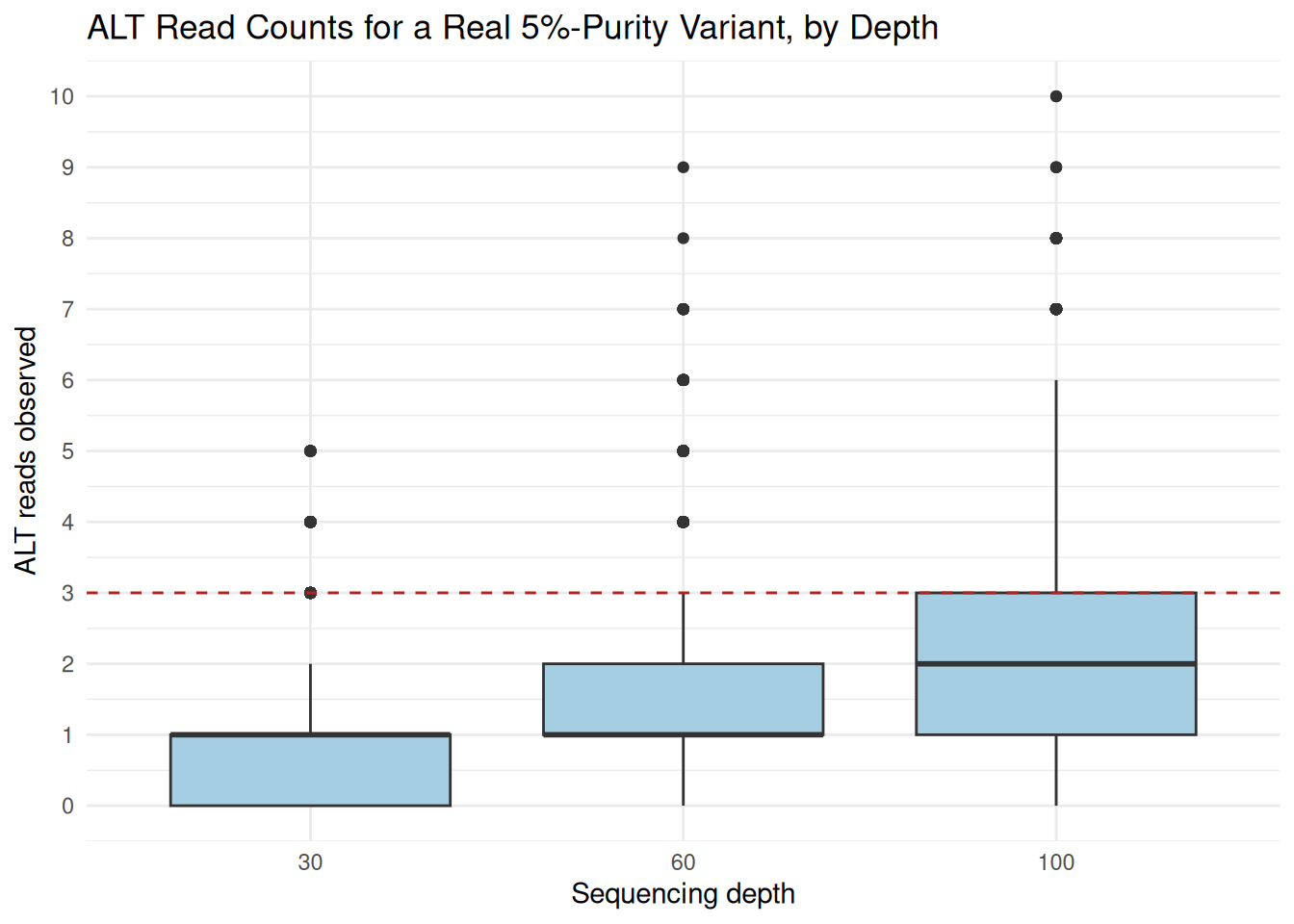
Compare that against the noise table above. Requiring 3 or more reads (the dashed line) keeps error-driven false positives negligible at every depth tested.
Real Cases
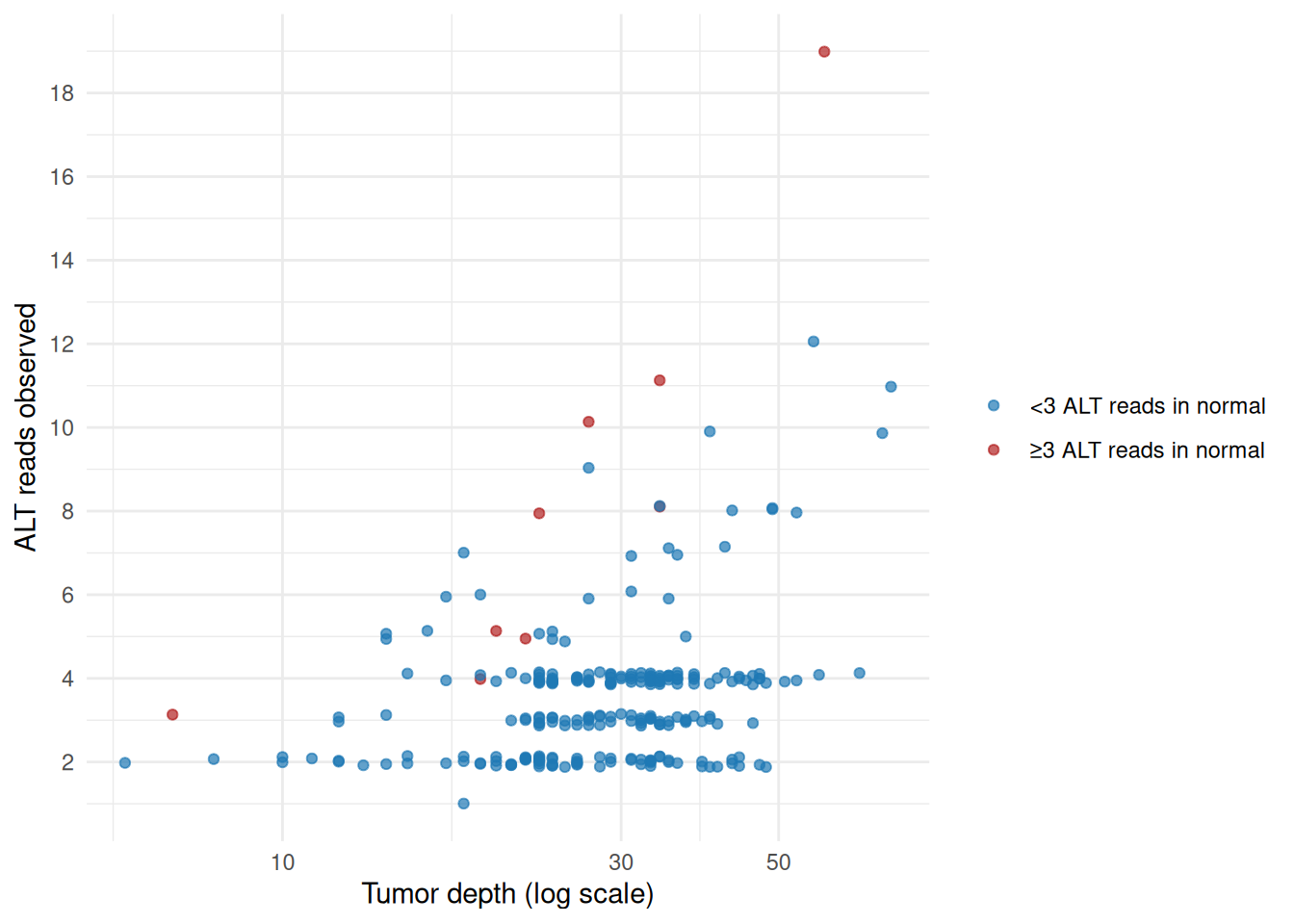
Real case 1: 257 candidate somatic SNVs from a WGS tumor/normal pair, with an estimated tumor purity of 5.8%. Tumor depth ranges from 6x to 72x (median 29x) — at this depth and purity, a real variant is expected to produce under one supporting read.
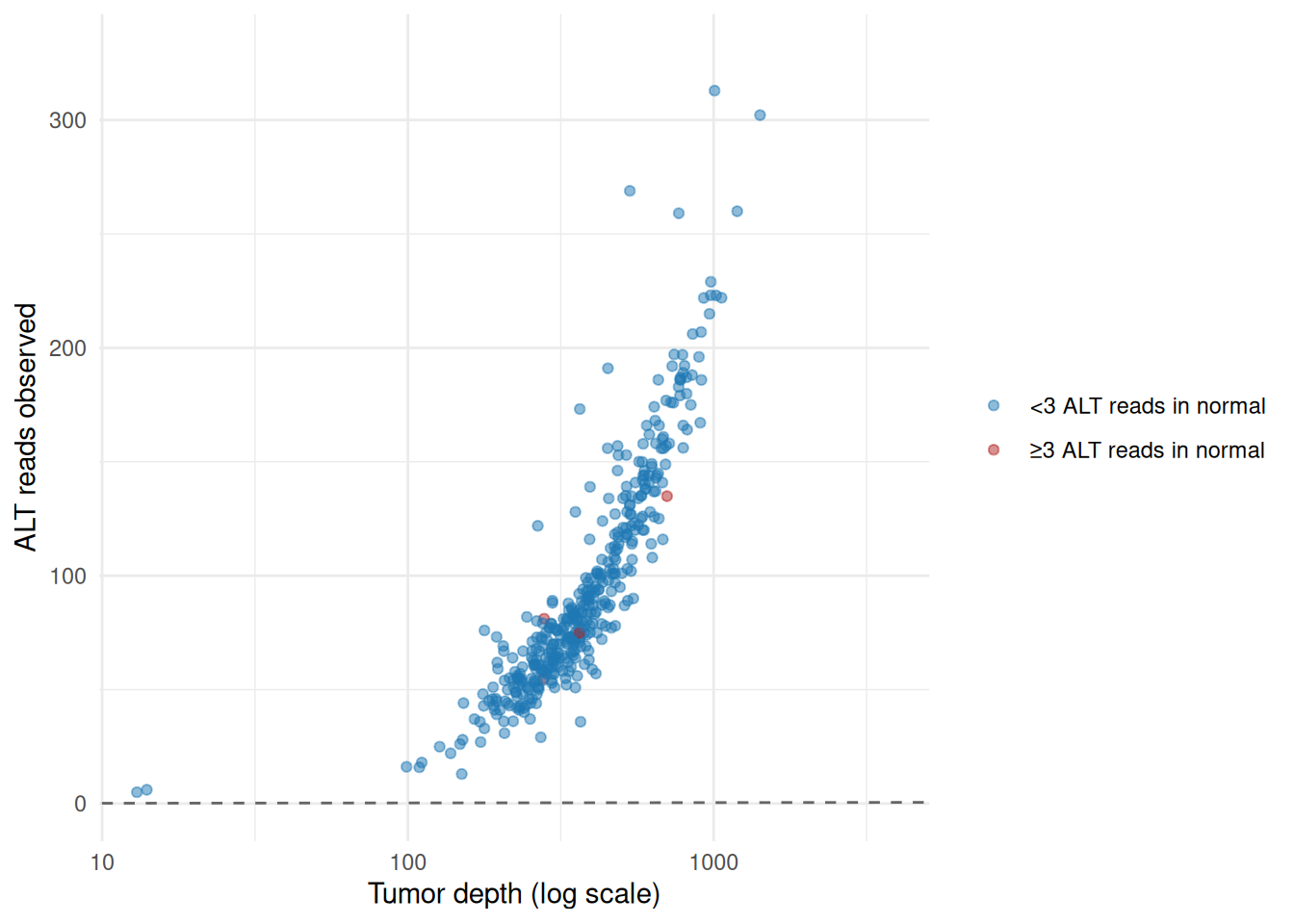
Real case 2, for contrast: a WES tumor/normal pair with a much higher ichorCNA-estimated purity of 28.6% and far greater depth — 416 candidates, tumor depth from 13x to 3819x (3819 is probably an outlier). Minimum ALT count across all 416 candidates is 5, and 91% have a clean normal.
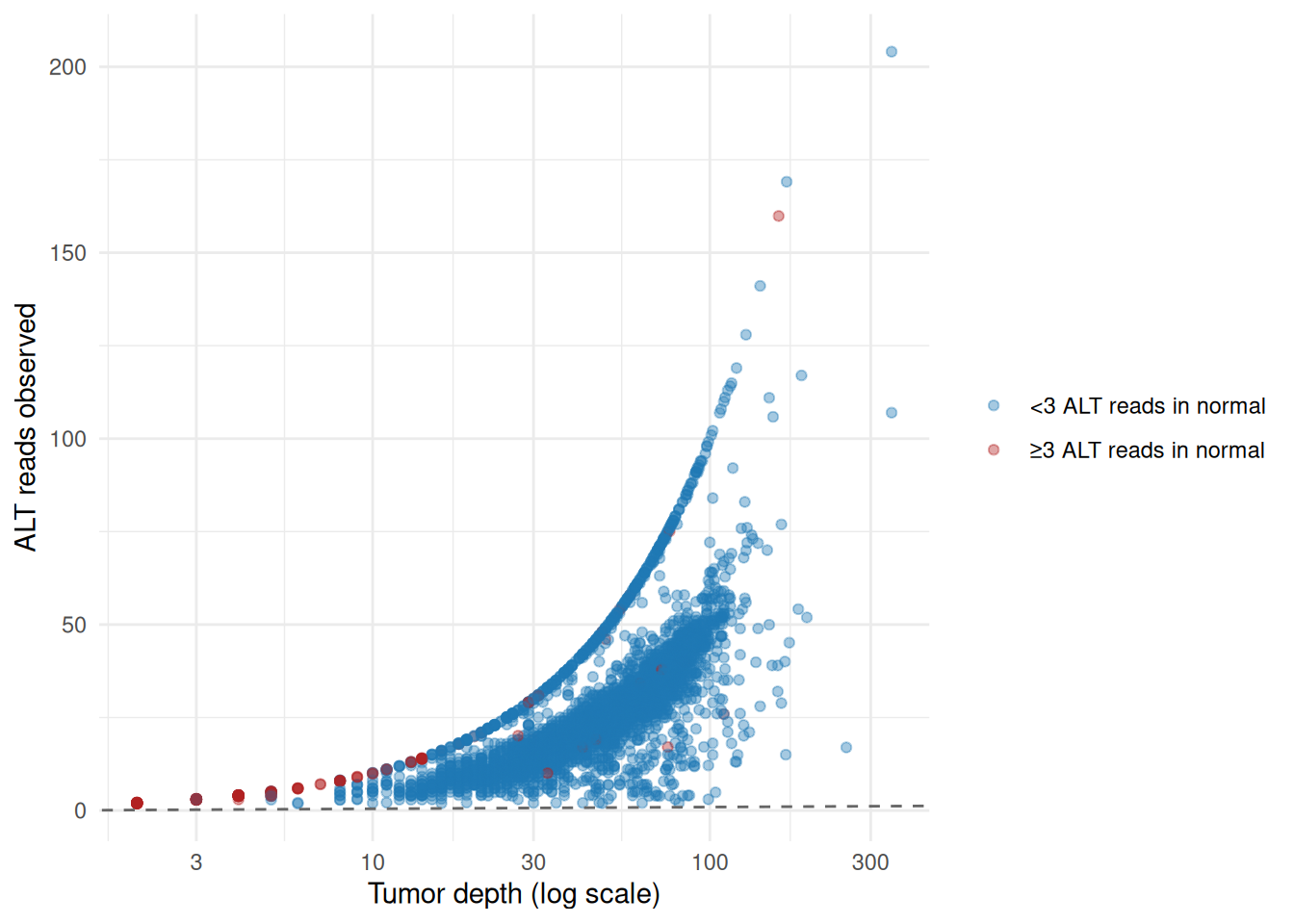
Real case 3, at the opposite extreme: a tumor/normal pair with an estimated purity of 93% — 3599 candidates, tumor depth from 2x to 346x (median 47x). Minimum ALT count is 2, and 89% have a clean normal.
Conclusion
So at 5% purity, if we are not able to increase the tumor fraction by sample preparation or enrichment of some type, the most direct fix is really deeper sequencing. At shallow depth the expected signal falls in the same regions as artifacts, but it does gain in reads with more coverage. A minimum read count is still worth imposing, but it only clears the very bottom of the noise. And the usual models that we use might not capture other the systematic artifacts — oxidative damage, deamination, mapping errors in repeats — that dominate low-read-count calls.
Reuse
Citation
For attribution, please cite this work as:
Barrantes-Reynolds, Ramiro. 2026. “When Is a Variant Real? The
Challenge of Low Tumor Purity.” August 28. https://ramirobarrantes.com/blog/2026-08-28-low_purity_variant/.